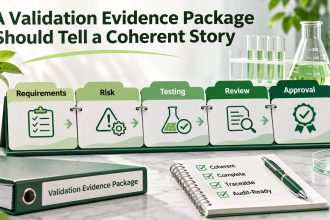

A package can contain every expected file and still be difficult to review. The reader needs to understand how the requirement, execution result and acceptance decision belong together.
Organize around the decision
Start with the system and scope, then connect the relevant requirements, risk reasoning, assurance activities and final disposition. Identify unresolved issues and explain how they affect the decision. The package should distinguish approved records from working material and historical versions.
For a hypothetical reporting application, the reviewer should be able to follow a calculation requirement to its test inputs, observed output, any failure and the accepted resolution. A folder containing a protocol, screenshots and a signature page may still be insufficient if those relationships have to be inferred.
Preserve the context of evidence
Include the information needed to interpret each result: relevant version, execution conditions, identity and timing as appropriate to the activity. Evidence captured from a different environment or configuration may be useful, but its applicability needs explanation.
Test the package with an independent reader
Ask someone who did not perform the work to reconstruct one important decision. Record where they need verbal explanation or an additional file. Those gaps reveal whether the package is self-contained enough for its intended review purpose.
Check links, attachment availability and version identifiers after export. A useful in-product relationship can become difficult to interpret if the exported package omits the target or uses an unexplained internal identifier. The review should include both the platform view and the delivered record set.
Validfor’s catalogue describes controlled PDF and ZIP exports from approved records. Its document repository and test workflow provide the surrounding context. This is a valuable capability to examine because the exported evidence should retain the meaning established inside the platform, including the scope of included records.
A good package lets an unfamiliar reviewer follow the decision. Its quality appears in the relationships it preserves and the questions it answers without additional explanation.
In recent years, validation processes across the pharmaceutical industry have been undergoing a major transformation. Workflows that were traditionally managed through paper documentation, spreadsheets and manual review cycles are increasingly moving toward digital validation platforms. As a result, life sciences organizations often evaluate solutions such as Kneat, Validfor, ValGenesis, MasterControl and Veeva when modernizing validation lifecycle management and compliance documentation.